Saturday, April 18, 2009

Record Review: The Decemberists - The Hazards of Love


By Daniel Greenwood
Release Date: 17/03/2009
Ragged Rating: *** (3/5)
In Three Ragged Words: Metal? What metal?

Up until this point in The Decemberists’ career, Colin Meloy has contained his storytelling into sole songs that are tied together by themes of self-deprecation and melancholia. The results are devastating. Picaresque, released in 2005, was the breakthrough record for the Portland-based band. It’s a record packed with miniature epics that work like short stories and, up until now, Meloy could be seen as a high calibre short story writer presenting his work in song. ‘On the Bus Mall’ is the tale of young prostitutes that ‘fuse together like a family’, while ‘The Engine Driver’ is the lament of someone unloved and strung along: “And if you don’t love me, let me go”. Castaways and Cutouts (2002) is perhaps The Decemberists’ lesser-known release and remains a well-kept secret. It finishes with ‘California One/Youth and Beauty Parade’ as Meloy calls upon all the urchins of society to join the toast of the town, to rejoice in their bedwetting and pick-pocketing.

The characters Meloy creates are forgotten souls, like ‘Eli, the Barrow Boy’: “dressed all in corduroy he had drowned in the river down the way”. Meloy’s narrator embodies the forgotten, reflecting like a ghoul upon the tragedy that has come before; or else he’ll narrate as an outsider, a feeling unfamiliar to the listener. The Decemberists’ music is tuneful and inviting, and before The Crane Wife (2007) it was hard not to love this band. In 2007 there were signs that Meloy’s songwriting was moving towards epic musicianship (two songs surpass the eleven-minute mark) overlooking the mini-epiphanies that define The Decemberists’ earlier work.

So here comes The Hazards of Love, a 17-part tragic romance hyped for its genre hopping from folk-pop all the way over to metal. There are chomping power-chords to be found, as on ‘The Queen’s Rebuke/The Crossing’ but metal it ain’t. It feels more like sea shanty-rock, an evolution of The Decemberists’ previous allusions to pirate-pop. The ‘metal’ is sparse enough, but the teeth crunching guitars feel a little unsavoury. Still, the impression remains that a record aiming for this sort of theatricality needs something pantomime ugly. It’s not unlikely that this new direction for the band will have fans of old chewing their bottom lip in confusion, and if you don’t enjoy the guest vocals (Becky Stark of Lavender Diamond as our heroine, Margaret, and Shara Worden of My Brightest Diamond as the Queen) early on in the album’s lifespan, you probably won’t like them at all.

There are moments of Meloy magic to be had here however, ‘The Drowned’ is the curtain falling on the album, albeit a curtain clawed down by the waves that ‘bear witness’ to our hero and heroine wedded beneath the rushing waters. It’s the saddest song Meloy’s written since ‘On the Bus Mall’ and it’s a suitable finale to a successful decade for this Portland-based band. Hopefully it’s a sign of things to come. May their next project find Meloy crushing listeners with the calibre of ‘The Drowned’, because it feels like all Hazards really needs to say is in this one last song. For now though, The Decemberists have every right to experiment.

Live Review: Papercuts @ the Legion, Old Street


via Ragged Words
By Daniel Greenwood


A recent Sunday Times Culture article heralded the return of shoegaze, a genre supposedly pioneered by My Bloody Valentine’s superlative album Loveless. According the article’s author Paul Lester, the influence of the aforementioned Dubliners can be seen in artists like Deerhunter, Sigur Ros, and Lily Allen. And tonight’s show in Old Street’s swanked-out the Legion is organised by Sonic Cathedral, a record label run by music journalist Nathanial Cramp, the sweetheart of Lester’s Times article. But there’s one problem, none of the bands performing here tonight are ‘shoegaze’.

Trailer Trash Tracys open the show with a pleasant sound that doesn’t suggest anything beyond the oblong shape of the venue, and certainly nothing on the scale of a cathedral. This band sound more like fans of the Crystals than Slowdive, in fact, there’s barely anything shoegazey about this band. The same can be said for It Hugs Back, who take an age to start their set, a wait that seems unworthy. IHB have recently released their debut record, and if they’re looking to ship units they’ll need to do better than this. Perhaps you could argue the band are using delay pedals so call it shoegaze if you will, but it’s more pint-gaze. There’s an element of the mundane about their performance, dragging on into the evening, it’s inoffensive and unconvincing.

Papercuts’ maestro Jason Quever has been busying around the venue all night, scribbling in his notebook and supping glasses of red wine. And as the band finally kick things off, he’s in good spirits. Papercuts write love songs, Can’t Go Back (2007) is a superb break-up record, but only ‘Dear Employee’ and ‘John Brown’ make it out tonight. There are calls for ‘Unavailable’, and this reviewer whimpers pleadingly for ‘Summer Long’. But this particular tour is in aid of Papercuts’ fine new record You Can Have What You Want, what Ragged Words’ own Tim Groenland rightfully calls one of this year’s sunniest. ‘The Machine Will Tell Us So’ and ‘Once We Walked in the Sunlight’ are nailed by the band, though at times hindered by a mix that needs the bass turned down. Quever returns for a drab solo performance, ignoring calls for crowd favourites, and it’s a meek end to a rather disjointed evening for all concerned.

Sunday, April 05, 2009

Match Preview: Everton vs. Wigan


via The Guardian
by Daniel Greenwood, Observer reader

When Everton were knocked out of the Uefa cup in September, the prospects for the season were grim. Though I never felt we had the financial clout to uproot any of the Sky-four, a battle for European football is now familiar to us Blues. But, as ever, Moyes has pulled it off. Playing a group of fixtures including Liverpool three times and Arsenal and United in close proximity gave Everton the thirst for the challenge. And now we face a Wigan side looking to steal our spot. The task for any team beneath the top four is to keep an eye over your shoulder, but Moyes also knows that a one-game-at-a-time philosophy breeds success, and believe me, if anyone else knows how to get Champions' League football, it's the Stoic Scot. And so we look to beat Wigan and achieve what in September looked so unlikely – a return to the top six.

Due a big game: Jô – The Brazilian has impressed with his positive forward play, but his sour time at City has put his progress back by several months.

Thursday, March 19, 2009

Film Review: Into the Wild (Sean Penn, 2007)


via Atlas Film
By Daniel Greenwood
This review constains Idealism and spoilers.


During the final deluge of academic work belonging to my university degree, I bought two Mark Twain books. One was The Adventures of Huckleberry Finn, the classic novel, and the other was Roughing It, written by Twain as he travelled around the southern United States. In the final days of essay writing and editing, these two books gleamed from their spot underneath my desk, I couldn’t wait to read something non-theoretical again. Huck Finn was very good, I ate it up quickly, but Roughing It was more of a slog, and in the final stages of the book, with Twain’s rather dull account of molten lava, I couldn’t wait for it to finish. Into the Wild has spoken to me more closely than Roughing It could.

I have never felt such an urge to leave the city behind, to do as Henry David Thoreau did, or as experimental folk-singer Justin Vernon did to record his debut as Bon Iver, For Emma, Forever Ago. Thoreau is quoted by the protagonist of Into the Wild, Chris (Emile Hirsch), a 23-year-old post-grad (snap): ‘Rather than love, than money, than fame, give me truth.’ It’s a line from Walden that’s also emblazoned on the cover of the Penguin Great Ideas mini-volume Where I Lived and What I Lived For. Thoreau’s beautiful idea, which he managed to achieve and describe so well is a tragic tale here for young Chris. But that’s only really a footnote, because Into the Wild is an exceptionally-shot movie that charters a vast trek across a beautiful country. That it’s a true story is a fact unknown until the end, and that it’s directed by Sean Penn is another example of his thirst for ideas, for the stories of tragic individuals. It doesn’t match The Assassination of Richard Nixon (Niels Mueller, 2004) for pain-value or grit, but it’s Penn musing on death again. He’s interested, and so am I.

Chris is fed up with ‘things’, with the burden his parents’ troubled marriage hands down to him and his sister Carine (Jena Malone). Chris burns his cash, gives his 24,000 dollar college fund to Oxfam and embarks on a Quixotic journey across America. The opening scenes of Into the Wild are of Alaska, how Chris got here is recounted in stylishly edited sequences that make sure the narration is never boring. Carine narrates, never questioning her brother’s reasoning, only recounting the violent quarrels of her parents, underlining why Chris’s disappearance into the world is more desirable than being stuck at home.

Perhaps Chris is similar to Timothy Treadwell, better known as a man eaten by bears in Grizzly Man (Werner Herzog, 2005). To be ‘happy’, it’s a belief in yourself that you need, an inner calm which can transform the world around you. Chris oversteps this mark. The moment that he’s assaulted by a police office, or border patrol, as he sits happily on the empty carriage of a freight train the fun is over. This is the harbinger, the prophecy. If only Chris had gone on home.

The problem is that he loses sight of his goal, and the desire to live alone and off the land in Alaska is his downfall. What Chris strives for is greatness, the greatness he reads about in Tolstoy’s novels, in Thoreau. Personally, it’s Thoreau’s pal Ralph Waldo Emerson who stands over this film: ‘The secret of fortune is joy in our hands. Welcome evermore to gods and men is the self-helping man. For him all doors are flung wide; him all tongues greet, all honors crown, all eyes follow with desire. Our love goes out to him and embraces him because he did not need it. We solicitously and apologetically caress and celebrate him because he held on his way and scorned our disapprobation. The gods love him.’

Wednesday, March 18, 2009

Interview: Ponytail


via Ragged Words
Article & Images by Daniel Greenwood
Flickr Gallery

Ragged Words are meeting Ponytail at the Lexington in North London where, tonight, the band will perform the penultimate leg of their European tour. Ponytail are Molly Seigel on what you might call vocals, she certainly fronts the band, with guitarists Ken Seeno and Dustin Wong either side of her, and Jeremy Hyman on drums. Ken is a little homesick:

‘We’re going home on Thursday and I think part of me is already on that plane. I’ve got one leg on the plane and the other is on the stage playing the show.’ Judging by the frenetic energy of Ponytail’s live performance, this image of Ken isn’t entirely discountable.

‘That’s an amazing image,’ adds Dustin.

‘I have long legs.’

Baltimore, Maryland is home to Ponytail, a city recently gaining notoriety in the light of breakthrough acts such as Dan Deacon and Beach House. Baltimore is also where Animal Collective grew up, though they spend their time elsewhere now. For Ponytail, how does Baltimore compare to a place like the Brooklyn, the capital of buzz?

‘It’s so different,’ says Molly, the angelic-looking spearhead of Ponytail. ‘The city is so small, just the fact that it’s so much cheaper. It’s just friends doing stuff together. I think that, personally, the scene in Baltimore is still really good for a small city, but it doesn’t have as much energy as it had a few years ago. Also, with the buzz of it, with Dan Deacon getting really popular, it kind of created a more, well, maybe people were trying to get famous a little bit. It’s just the fact that it got attention and changed.’

Popularity is something the band are curious about, particularly in an age where it’s difficult to tell who is more popular – the artist selling more music, or the artist with statistical proof on last.fm or myspace profiles:

‘The other day I was trying to work out if anyone actually listens to our music,’ says Jeremy Hyman, Ponytail’s curly-haired drummer.

‘Not if anyone listens to it,’ Molly adds. ‘But if people like it. That’s what I was thinking about.’

‘Yeah, I wonder that too,’ agrees Dustin. ‘We have no idea.’

‘When we were in college,’ Jeremy continues, ‘and starting this band, bands that I thought were huge we’d meet eventually. It’d be like, “Oh, no, you’re not.” It’s all relative.’

‘It’s just numbers,’ Ken concludes.

This genial young band gives an impression that belies the internet era they’re living in. They’re each grounded and focused, and though tired at this point of their tour, they remain philosophical.

‘The most depressing thing is – I haven’t been on the internet in a while, but today I went on – on myspace they’ve changed it: it now says ‘statistics’ for the band,’ Jeremy stresses the term with disbelief.

‘No way!’ proclaims Dustin.

‘Stats!’

‘What does that mean?’

‘I mean, is that it?’ Jeremy reclines into his seat, pondering.


For Ken, the solution to this modern dilemma is simple: ‘If I play a show and I feel kind of down about it, if I’m unsure that the sound was good or something, if at least one person comes up to me and says they enjoyed it or they want to shake my hand, I feel really good. Just one person coming up to me at the show and I feel really good.’

It could be the case that Ponytail’s style will alienate some listeners with the, at times, primitive nature of their sound. Molly’s work at the front of the stage borders on primal, she acts as a guide, shrieking and squalling through the maelstrom of energy conjured by Jeremy’s brilliant percussion work and the unrelenting melodies amassing between Ken and Dustin’s guitar-pedal wizardry. But how are people reacting to Ponytail, and how might that inform their development as a band?

‘Smiles,’ says Dustin. ‘I like smiles a lot, that helps.’

‘I think a lot of what we do is solidified live,’ Jeremy says. ‘If a song isn’t working well with the audience then it might change. It’s different for every song.’

Ken comes across (as do each member of Ponytail) as thoughtful, basing his opinions on experience: ‘A couple of times on this tour, after a show, people have been coming up to me and saying, “Thank you, thank you for coming.” And I’d say, “I was booked to come here anyway, thank you for coming.” It wouldn’t have been a good show without the audience, so it’s an equal part. The last time I had that was in Brighton. London’s awesome, people in London remind me of New York – they bring the mosh. And that’s fun once in a while, just to get punked and thrash around.’

What about negative reactions, are some people turned-off by the lack of familiar song structures? According to Dustin, they are: ‘I think some people are definitely upset about it,’ he says.

‘It’s a possibility’, Ken says. ‘But we don’t invite it, you know? It seems to me that people who are fans of our music are people who are just fans of music. Not necessarily fans of being ‘cool’. The feeling is what they’re after, and that’s what we’re after too. I think it’s kind of hard sometimes when you’re dealing with traditional elements of music that are kind of a dissonance, or sometimes you throw that word “art” around, and people start getting turned-off.’

‘Yeah, we don’t want to upset anyone or anything, that’s not our intention,’ declares Dustin.

If Ponytail were unsure about their popularity in London, tonight they need not worry. It’s a full-house upstairs at the Lexington, and the band manage to whip up a frenzy. The ‘mosh’ that Ken described earlier proves him right, they do bring it, but it’s completely innocent. It’s a varied clientele, perhaps the most energetic of the band’s followers is a man in his forties, re-living his teens, thrashing around amidst the seismic shift in ‘Late for School’. It’s an audience of minor celebrities also – Max Tundra can be seen defending himself with outstretched arms against the revelers that include support act Gentle Friendly.

The band will return home to rest for a little while before heading off to Austin for the annual SXSW festival. Molly hopes the band can find the time this summer, in Dustin’s basement, to finish writing new material and have it recorded in the winter. But the band aren’t sure about where they’ll practice this year. Jeremy likes the idea of Dustin’s basement, ‘it’s pretty cool in there’, he says. But Dustin disagrees: ‘Don’t you remember the summer practices? We were sweaty as hell, man!’ Wherever Ponytail find to write new material, they’ll have a doting audience waiting for them in North London when they’re done. Tonight, London and Ponytail brought the mosh.

Words & Live photo: Daniel Greenwood

Friday, March 13, 2009

Record Review: Loney, Dear - Dear John


via Ragged Words
By Daniel Greenwood
Release Date: 02/03/2009
Ragged Rating: **+ (2.5/5)
In a Ragged Word: Pleasant

The first line of Loney, Dear’s homepage reads: “Every night before I go to bed I try to find a not so good review of the new album, and I get what I ask for.” These are the words of Emil Svanängen, the man behind Loney, Dear’s new record Dear John. Svanängen’s interest in the critical reception of his new record isn’t limited to corners of his website, it also finds its way onto the record, specifically on ‘Harsh Words’ where Svanängen pleads with someone “not to use harsh words over me, over what I do.” He’s asking you not to say he doesn’t try hard, as his voice gets lost in a flurry of percussion. It’s clear he does try hard – the ambient elements of the songs are sewn together meticulously – but you’d have to be a hardened Loney, Dear fan to find this cute at all.

There isn’t really any space for ‘harsh words’ in criticising Svanängen’s music, but the fact that he’s underlined a problem stops the music from moving somewhere meaningful. The real snag is Svanängen’s vocals. The strange layering of voices is grating at times. The lyrics come off as superfluous as much of it amounts to lonely muttering and if not muttering, then throwaway nah-nahing, as on ‘Airport Surroundings’. This is a pop record, with the Scandinavian drum machine beats reminiscent of weaker Tough Alliance tunes. It’s hard to shirk the thought that Bavarians do it better though (in Loney, Dear’s case) and the melancholy that Svanängen aims for is what Lali Puna nailed on Scary World Theory.

It’s hard not to mention Jens Lekman in a review for a Swedish pop album, but he is the zeitgeist, the pinnacle. Dear John lacks what Lekman has by the bucket load: wit. And at the moments when it’s most needed, if not to let the listener in, it just isn’t there. This is a cathartic exercise for Svanängen, as was the case on Solonge, and Loney Noir, but the catharsis is the artist’s own. He isn’t sharing much, and that stops you from accessing a record that is entirely pleasant and well-intentioned. Sadly, it doesn’t feel like that’s enough.

Thursday, March 12, 2009

Film Review: The Savages (Tamara Jenkins, 2007)


via Atlas Film
By Daniel Greenwood
This review is unsure of itself.


Here is a dour though accurate portrayal of the strife between two adult siblings, underwritten by the decay of their demented father. Two fine actors compete here as brother and sister - Philip Seymour Hoffman as Jon Savage, Laura Linney as Wendy Savage - a simmering feud that amounts to a tally of who is the more selfish. Jon is a lecturer in the midst of writing a book about Bertolt Brecht, the great dramatist, while Wendy ‘temps for money’ and is a ‘theatre person’ in her spare time. Their father Lenny (Philip Bosco) is left in their care after the death of his girlfriend, and the painful procedure of selecting a home for him to effectively die in haunts The Savages. Both Wendy and Jon are middle-aged and single, though they each flirt with marital commitment: Jon with a Polish intellectual whose visa runs out, and Wendy with a married theatre director who arrives on her doorstep in search of sex. ‘Why don’t you marry her?’ Wendy asks of Jon’s departing lover, but Jon’s perhaps too much a cynic, or too much the purist to marry tactically.

This is a well-shot film, and with Seymour Hoffman and Linney on screen it’s very watchable. But it’s terribly unhappy, too. The inner-city scenes are akin to those of Michel Gondry’s American romantic movies such as Eternal Sunshine of the Spotless Mind, though lacking the childlike innocence of a woolgathering Jim Carrey. Arizona is where Mr. Savage - Lenny - has to be collected from and it’s presented as a sunburnt suburb where elderlies drive golf carts in the streets, where the glare of the sun is mind-numbing. On the other hand you have Boston where much of the story takes place, and where Jon and Wendy find a new home for their father. Boston is a dark, wintry place, and drained of all colour there’s not a speck of sunlight let alone an Arizonian glare.

It’s ok to make a film depressing, I’m totally OK with that but there has to be a release. I’m not talking about a camp-as-Christmas Life is Beautiful (Roberto Benigni, 1997) comedy-holocaust release. Just brief moments to lighten the gloom. I believe there is a basic, if not fundamental sense of humour in a person, if not in me. And that’s what costs The Savages some of the richness it tries to achieve. It’s that these characters are building up so much stress but things never really boil over. If things fail to explode it’s because of intermittent moments of comedy, but they ain’t here! Perhaps The Savages doesn’t lack a sense of humour but wit instead. In Laura Linney you have an actress who deals in self-deprecating comedy, The Squid and the Whale (Noah Baumbach, 2005) for example. But in parts this self-deprecation becomes unsavoury wretchedness (I suppose that’s pretty rich coming from me, Interiors is a current favourite of mine). It just feels like what Tamara Jenkins has tried to do with these characters comes off a bit sulky, unrealistic in Wendy’s case. It may even lack the beauty of real tragedy, you know.

What troubles me after watching The Savages is that I don’t know what’s wrong with it, there just is something wrong with it. That’s the ultimate failure of a review of any kind, never mind the film: there’s something you don’t like about it, but, er, dunno what that is. Perhaps this cold film suffers because it has such a monstrous, actorly-duo in Philip Seymour Hoffman and Laura Linney. These siblings are savages, and they star-the-hell-out-of this savagely glum movie.

Sunday, March 08, 2009

Record Review: Julie Doiron - I Can Wonder What You Did with Your Day


By Daniel Greenwood
via Ragged Words
Jagjaguwar
Release Date: 09/03/2009
Ragged Rating: ***+ (3.5/5)
In a Ragged Word: Charming

Julie Doiron’s appearance on Lost Wisdom – Phil Elverum’s latest as Mount Eerie – is the perfect pre-cursor to Doiron’s I Can Wonder What You Did with Your Day. Both records clock out at around half-an-hour and each exude bedroom-to-basement, lo-fi auras. Perhaps Lost Wisdom’s best moment is Doiron singing “Emptiness prevailed/emptiness in the house“, following on from Elverum mourning a double-crossing. I Can Wonder feels like an alternate ending to Lost Wisdom. It begins with ‘The Life of Dreams’, with Doiron grateful for the “good people all around me.” These snippets of good humour and thankfulness never feel ugly – never over-sincere or sickly.

In 2009, Noah Lennox and Animal Collective have made familial love the zeitgeist, but Julie Doiron has been doing this stuff for ages. And on the latest album of catalogue that stretches back over a decade, it’s not so much euphoric but ataractic and tranquil. On ‘Nice to Come Home’, Doiron describes coming home from the cold to turn on a lamp and play guitar, only to think of a distant loved one who’s probably doing the same: “I can wonder what you did with your day/I’d like to tell you ‘bout mine but I’ll wait.” I Can Wonder isn’t simply a woolgatherer’s exercise, ‘Consolation Prize’ and ‘Spill Yer Lungs’ are mini-rockers with chugging distorted bass and guitars working wonderfully with Doiron’s layered vocal harmonies.

Doiron’s finest trait is her down-to-earth-ness, and it’s this aspect of her records that seems most affecting. Songs like ‘Nice to Come Home’ won’t invade your headspace immediately, but this is the kind of music that accompanies you away from a stereo or a computer, from headphones or even live performance. Doiron’s subtle and self-deprecating anxiety smiles at you from the fringes of your own solitude. Perhaps that’s what records like I Can Wonder and Lost Wisdom are for: music to listen to on your own, your right to be selfish. It’s difficult to pull-off a personal record, but Doiron has learnt the trick, the kind of skill she seems to have built-in: “I was forgotten, yeah I was forgotten” the singer claims on ‘Loves of the World’. This record isn’t for everyone but, like Lost Wisdom, it’s just for you.

Thursday, March 05, 2009

Film Review: Mr. Woodcock (Craig Gillespie, 2007)


via Atlas Film
By Daniel Greenwood
This review contains nostalgia.


Being fifteen was tough. I had no luck with girls, no money, lots of time and a constant fear of having my Nokia 3210 stolen by people bigger than me. Wait, things haven’t cha–look, if there was one little joy in my life it was Seann William Scott. I saw American Pie (Paul Weitz, 1999) on the last day of school before our Easter holiday. I’d tried to catch it, or sneak it, in the local cinema but couldn’t get in. It was a 15, dude. But American Pie wasn’t really about Seann William Scott, it was more to do with that pie mutilated by Jim (Jason Biggs), while his mum and dad were out. Indeed, that movie was more about a lonely young dude (played by a twenty-something Briggs), and not about Steve Stiffler, the Stiffmeister (William Scott) getting all the chicks.

Though that’s not really why I looked up to Stiffler, it was his confidence that made him a sort of demi-God, his arrogance. How could teenagers be so confident? It was unthinkable. I recall riding home on the bus having just seen American Pie 2 (James B. Rogers, 2001) and devising a plan with friends, trying to think of a way to throw a Stiffler-esque party on a beach somewhere. We never had a party as glamorous as American Pie 2’s sandy soiree, but we entertained the idea for long enough for it to be satisfying. Watching Role Models the other week, it dawned on me what an idol that man was to us fifteen-year-olds who were there at the right time, pubescence, to appreciate the greatness of this actor.

Sitting down to watch Mr. Woodcock, it didn’t matter who was in this film or what it was about, it had the Stiffmeister. Who knew how many people he’d tell to ‘fuck off’, or how embarrassed he’d be by having some kid urinate on him and mistake it for champagne. Stiffler always comes out on top, he was a soldier. But I’ve grown up (a bit) now, and Seann William Scott is (a bit of) a changed man. He isn’t alongside characters like Shit-break anymore, instead he’s kickin’ it with Susan Sarandon as his mother, Beverly, and the stoney-faced Billy-Bob Thornton as Jasper Woodcock. The film begins in a gymnasium, and it’s already clear that Mr. Woodcock is a dick. He gives a line of pre-pubescent pupils a lecture on the greatness of the basketball, before hurling it at them.

It turns out that John Farley (Seann William Scott) was one of those kids, but now he’s grown up and has published a self-help book entitled ‘Let Go’. John’s a bestselling author, and in receipt of a homegrown award, he returns to stay with his mother Beverly. Mr. Farley died some years ago, and Beverly seems to have found a patriarch to fill the fatherly role - Jasper frickin’ Woodcock. John is still a nobody to Woodcock, and though the teacher doesn’t remember the pupil, John is painfully aware of the beast that Woodcock is. In fact, much of this film is ugly jokes about Woodcock sleeping with John’s widowed mother. But, give the man credit, there are no misplaced ‘boobies’ ala Role Models, or the rest of William Scott’s generally flatulent body of work.

John and Woodcock reignite their feud, John’s self-help ego dissolves amidst his rage. ‘Don’t meddle in other people’s lives’, he says to himself, like a mantra, before meddling in his mother’s love life. It’s a pretty cute take on the concept - everyone’s fallible to the kind of behaviour on show here - jealousy, lying, breaking and entering. But that’s about it in the way of cuteness, bar a few laughs, Mr. Woodcock turns on its own hinge and musters a change of heart, tying things up around the 90-minute mark. It’s strange to see that Seann William Scott is growing up, and though he’s in a film with a sexually-connotive title, he’s toned things down somewhat, and I suppose it’s about time I did the same.

Tuesday, March 03, 2009

Music Video: Deerhunter @ Noise Pop


How long have Youtube allowed hour long footage? Anyway, thanks to Chocolate Bobka for highlighting this wonderful video of Deerhunter at Noise Pop in San Francisco last week. Anyone who hasn't listened to this band yet, you're missing out.

Set list:
Intro + Cryptograms
Disappearing Ink
Rainwater Cassette Exchange
Never Stops
Spring Hall Convert
Nothing Ever Happened
Famous Last Words
Saved By Old Times
Cover Me (Slowly) + Agoraphobia
Hazel St.
Circulation

Monday, March 02, 2009

Music Video: Vivian Girls - Second Date on Pitchfork.tv

ADD is a new feature from Pitchfork.tv where artists perform songs and have them recorded in old school Tascam tape decks while filmed with VHS cameras.


Such a lovely song.

Film Review: Michael Clayton (Tony Gilroy, 2007)


By Daniel Greenwood
This review contains spoilers.
via Atlas Film


Technology today - the Internet, television, DAB radio, mobile phones, mp3 players, electric shavers, curling tongs, satnavs, super hoovers - it’s everywhere. But you can turn it off. It’s also at the heart of this really rather fine film from director Tony Gilroy, a dude who had his hand in all the Bourne pies, and in Michael Clayton you can tell. The same murky throbbing that follows Matt Damon around foreign cities accompanies George Clooney (Clayton), as he deals well-enough with a gambling habit, huge debts, and worst of all an evil corporation - U-North. The face of these evil scum who hate human life and love money is Tilda Swinton, one of the film’s main roles performed by Brits pretending to be Americans. They pretend well-enough, Oscar well-enough for Swinton and Oscar near-enough for the other Brit, Tom Wilkinson, as madman Arthur Edens. But as ever it’s Clooney who steals the show with his espresso chugging jaw-line and exceptional deviation between witty and damaged.

Michael Clayton’s car is blown up early in the film, but in a Memento-esque (Christopher Nolan, 2000) manoeuvre, Gilroy gives us the ending first and then backtracks four days to witness the run-up to this fiery event. The bomb has been planted by two men who span the whole film techonologically f***ing with people who are close the to U-North’s uber-law suit. The equipment they have is a real threat to personal privacy and to human rights - this has to be a message from Michael Clayton. But there is a superlative twist at the movie’s death that underlines the premise that there’s a balance in the universe which also applies to technological advances. They can be used for good and evil. Whether Michael Clayton as a film tells us of whether it’s of use at all, is something entirely up to you or I. It works against Clayton, but then he uses it with the right people (police) in tow for it to be seen as positive.

Clayton has pissed some people off, big time. Know why? He plays it straight, brother’s a janitor. If Clayton taught me a lesson it’s that you got to use what you can to do good. You got to get your hands dirty. But Clayton’s not the primary school janitor or caretaker, he doesn’t have a dog called Blue who accompanies him in the corridors he steps proudly down with keys jangling on his belt. No, Clayton’s got Jason Bourne-syndrome - people want to blow him up. God, it’s hard being handsome.

As with any film about law or court cases there’s a lot of talk about stipulations and, well, laws. Gilroy does well to keep the film bubbling along, there are enough horrible individuals here to breed ire and thus interest. Swinton is Queen of my hatred as Karen Crowder, a character who everyone loves to hate and then feel a slight tinge of sympathy for. She’s terribly unhappy. Gilroy gives his audience the pleasure of witnessing Karen ready herself for public facades by intersplicing these images of her lonely preparation with the events she’s rehearsing for. What you have are rather scathing interpretations of public speaking in this kind of corporate arena - are these people serious? Karen says in a video interview that she loves what she does, but she also has to conjure this up as she dresses alone before hand (in another of the interspliced scenes). She has to convince herself of something she doesn’t herself believe. She’s as clueless about her life as Arthur is deranged in his underpants at a board meeting. No wonder Swinton won an award, she’s more even more convincing for appearing so painfully unconvincing.

Unlike Memento - *increases firewall protection* - Michael Clayton succeeds with the backwards storytelling routine. The film would have stood-up without the early, though only partial, revelation but it certainly gives it a sense of novelty. What you have in George Clooney is a serious actor who will get improve through his autumnal years. He’s got enough money now to experiment, just like the evil corporations.

Saturday, February 28, 2009

Article: Straight outta Brooklyn: A Golden Age in American music


By Daniel Greenwood
via Seven


It has been said that, when times are hard, the art gets better. To compare the state of the American economy to the health of indie music in America shows that there is some truth to this idea. The rude health of American music is symptomatic of the sheer number of lauded artists (big and small) emerging from Brooklyn, New York. At the top of the scale are TV on the Radio, whose recent release Dear Science headed numerous album polls last year; Rolling Stone and Spin are two of the bigger brands who plumped for the act. In fact, American music dominated year-end charts, with British act Portishead and Aussies Cut Copy the only acts outside of the States to really trouble critical listings.
TV on the Radio are a bi-racial alternative rock band; four of the members are African Americans (Gerard A. Smith on keys and brass, Kyp Malone on bass, singer Tunde Adebimpe and Jaleel Bunton-Drums as percussionist) while fifth member and production hot-shot Dave Sitek is a white American. The significance of this idea of a bi-racial act is in line with the recent inauguration of America’s first African American president, Barack Obama. Take the track “Golden Age” from Dear Science: “There is a golden age/and it’s coming round.”

Leading indie website Pitchfork ranked Dear Science at number six in 2008 and their writer Eric Harvey commented: “One last sigh of relief that "Golden Age" in December isn't a sad curio of a nation afraid to embrace difference on November 4th [Election day], but instead stands as a bona fide fucking anthem going forward.”

For Harvey, this “Golden Age” is one of racial harmony, of kicking out Bush the draconian; but it can speak equally for the brilliant lights of the Brooklyn scene.

Telepathe are an electronic duo residing in Brooklyn, but with the release of their debut record Dance Mother, they haven’t been spending much time in the New York borough. Their record was produced by TV on the Radio member Sitek. It is experimental electronica and minimal, simmering with reverb-laden guitar moments akin to Sitek’s work for TV on the Radio.

In January, I spoke to Busy Ganges, one half of Telepathe, in the build-up to their debut release. Originally from Los Angeles, she said: “I’ve lived in Brooklyn for a few years now and I feel like I’ve been lucky to see live so many interesting and innovative bands over the years. But this past year, I feel like I’ve barely lived here. We’ve been touring, so I haven’t actually been out to any shows in Brooklyn. I feel like the scene has become so big that it’s almost overwhelming. I hear about a new band every single day.”

Ganges has a point. The overwhelming nature of the scene has lead to some bands spilling out into other parts of the country. Rob Barber and Mary Pearson of High Places comprise one of these acts who, in January, upped-sticks to Los Angeles, home of No Age and the Smell – perhaps America’s most relevant and, currently, most famous indie setting. High Places marry together an Animal Collective (once NYC-based) instinct for samples and ambient sounds, many of which are electronically modified sounds recorded at home, like plastic bags and even food bowls floating in a paddling pool full of water. High Places are perhaps the most under-the-radar of Brooklyn’s recent graduates but with much in common with the superlative Gang Gang Dance, another similar to Animal Collective.

The thing that ties bands such as TV on the Radio, High Places, Gang Gang Dance and Animal Collective together is their continental sound. The cover for Gang Gang Dance’s St. Dymphna is adorned with the image of lead singer Lizzi Bougatsos wearing colourful, almost royal Arabic headgear. The samples that tinge their breakthrough record hint at Middle Eastern influences with the kind of beats reminiscent of African American hip hop acts. It all adds up to a vibrant and colourful spectrum of artists that seem to cover so many genres that it all merges into one – a golden age for art.
Though artists like High Places have drifted away from New York’s epicentre, there is a constant germination of new acts. Vivian Girls and Crystal Stilts are two bands to have achieved international acclaim with their debut albums in late 2008, along with the lesser-known experimental dance trio Lemonade.

For all the hyped artists, such as Vivian Girls and Crystal Stilts, dominating the blogosphere over the past 12 months, one band is on the brink of doing something wonderful. This band is Grizzly Bear, the Brooklyn-based quartet of Ed Droste (vocals), Chris Taylor (bass), Daniel Rossen (guitar) and Christopher Bear (drums). Veckatimest, their second studio album, will be released in May and has been described by indie-hegemonic Pitchfork as “one of the big ones”.

But 2008 was no dry year for the band. Rossen teamed with friend Fred Nikolaus to release their long-anticipated 4AD debut under the Department of Eagles guise – In Ear Park. What you can expect from Grizzly Bear’s new record will be similar to the Department of Eagles’ tone, a spirited sound lit by the ruffle of acoustic guitars and droning piano keys. In Rossen, Grizzly Bear have a folk-virtuoso, a skilled arranger whose input on 2006’s superlative slow burner Yellow House cannot be ignored. The band is on the verge of breaking into the corner of the mainstream inhabited by Seattle-based and much-admired folk crooners Fleet Foxes. In simpler terms, Grizzly Bear have the chance to hold the gong for 2009 as TV on the Radio did last year.

The Brooklyn scene is in the throes of a golden age. But what is most wonderful about it is its eddy; you cannot identify one influence for these bands. Thanks to the internet – the blogging culture that desperately and adoringly attempts to charter the rise of these bands – much of it can be witnessed from outside the city itself and from across the pond. As some acts move on and those such as Grizzly Bear scale the international heights, new bands are moving in and playing their first shows. The scale is large, but with TV on the Radio stirring styles at the top and the likes of Lemonade reinventing rave-culture at the other end, there’s plenty of gold to mine.

Friday, February 27, 2009

Film Review: Interiors (Woody Allen, 1978)


via Atlas Film
By Daniel Greenwood
This review is depressing (and contains spoilers).


The fun thing about watching a Woody Allen film is digesting it afterwards, chewing it over with the teeth in your head. But many people won’t get to the ‘afterwards’ part of Interiors, a film that is completely overcast. In three years - 1977, 1978 and 1979 - Woody Allen came up with Annie Hall, Interiors, and Manhattan. Holy carp, that’s three films better than any of the trillion some Hollywood directors make. In between Annie Hall and Manhattan, two little charmers, is one great big stinking misery fest. And you know what? I think it’s my favourite.

It’s a film about three sisters - Renata (Diane frickin’ Keaton), Joey (Mary Beth Hurt) and Flyn (Kristin Griffith). These sisters are torn apart by the protracted, messy divorce of their parents. Their mother Eve (Geraldine Page) takes the separation badly. She’s clinically depressed, introduced in a scene early on in the film where she obsesses about the positioning of a table lamp against a certain shade of wallpaper in Joey’s apartment. It’s unnerving to see someone so fragile to the colour palette of furniture. These small incidents are impressed against the harsh truth that her husband Arthur (E.G. Marshall) doesn’t want to get back together with his wife, he wants to marry another woman. Indeed, he does, and this wedding is the grand climax to Interiors, played out beneath the roaring waves of a bitter, Bergman-esque bay.

Renata is a successful poet. Her husband Frederick (Richard Jordan) is jealous of her, claiming her praise of his own work (which the critics ravage) to be lying on her part. The man’s a fool. He’s a drunk and an adulterer, typified by a scene where he pretty much attempts to rape Flyn, the youngest of the sisters, a beautiful and successful actress. But she ain’t happy, furtively snorting cocaine in the garage late into the wedding night. Renata toils with her lifestyle, what does she care if she has some poems left over when she’s dead for other people to enjoy. She’s unhappy with her life, almost oblivious to the small shape of her daughter that seems to flit on the fringes of Interiors.

Allen’s deftest manoeuvre here is his use of sound, the film’s complete lack of music. The only music that’s heard is from a record put on by Arthur’s newly wedded wife Pearl (Maureen Stapleton) - so it’s within the film. It’s quite clever, all the sound is interior. The crashing, early morning waves are terrifying, it’s as if Allen’s layered them over one another, and it gives the effect of fearing the water might come crashing through the screen. The action on screen is unclear and I found myself squirming, edging closer and closer attempting to see what was going on.

You could write a billion-word dissertation on these sisters, every performance is bang-on, every little thing about Interiors is aching and creaking, built on shambolic foundations. In the real world, people can’t get jobs, but here are people with a choice about their lifestyles - people who can make a living from art - forsooth! But man Allen has conjured some desperately unhappy characters in this elegaic, unrelenting piece of cinema.

Monday, February 23, 2009

Interview: Vivian Girls


Gallery
By Daniel Greenwood

Vivian Girls are excited about beginning work on their second album and tonight they’ll be playing new material. I am interested to hear about the creative process seeing that much has been made of who the trio sounds like, rather than the standout quality of their record. ‘Tell the World’ is one of the album’s most immediately awesome tracks, a contender in various song-of-the-year polls. It’s a love song: “He sees what I see/He feels what I feel/I’ll tell the world about the love that I found.” There’s a real sense of simplicity about the lyrics which is quite remarkable considering the complexity of its subject:

“I wrote that song about my ex-boyfriend,” says Cassie. “He was really into psychic stuff, and we’d always try to be psychic together, it’s kind of creepy but it’s true. I don’t know. I wrote that song after we’d broken up but then we hung out again one time and I was like, ‘Holy shit, I’m still in love with him, it’s insane.’ That’s what it’s about.”

Read the article in full on Ragged Words

Sunday, February 22, 2009

Caught Live: Parts & Labor


Thursday 19th February @ Cargo, London
Gallery

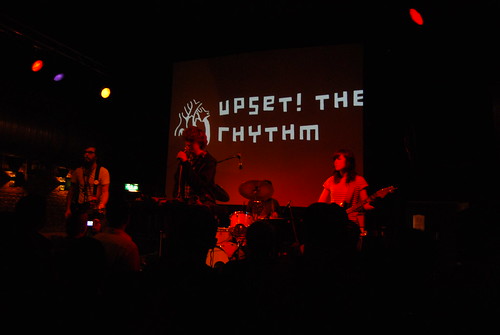
Thanks to the wonderful work of the Upset the Rhythm gang, London has been graced by some of North America’s best new bands. Recently we’ve had High Places, Crystal Stilts, Wavves, Women and tonight it’s Parts & Labor. This is Upset the Rhythm’s 199th show according to Dan Friel, on keys and vocals for the headliners, and here’s to another two-hundred shows. Brighton three-piece Cold Pumas open, excelling under the defunct disco ball. Their triangular sound contains two guitarists, Oliver Fisher and Dan Reeves, and vocalist/drummer Patrick Fisher. At the point of their blockbusting finale they’ve gathered a decent and receptive audience which includes impressed-looking Parts & Labor members. They’re a band to keep an eye on.

Parts & Labor begin their set as Receivers does, ‘Satellites’ surges through Cargo’s gig room, dragging punters closer to the stage with each humongous chorus. This band has an impressive sound, the first thing that grabs you is the epic wave of cymbals and keys, but Receivers’ finest moment is the incendiary guitar riff on ‘Solemn Show World’, cutting through this gargantuan sound. Sarah Lipstate wields the axe, she’s superb. There’s also something of an eighties synth-vibe to these tunes, with Dan Friel all smiles as he busies away at his desk of pedals and wires. It typifies the wholesome nature of Parts & Labor – there really is something for everyone.

The front of the audience is a sight to behold, accentuated by the flitting of one fan’s red mohawk, bassist BJ Warshaw succumbs and joins in, raising his bass aloft like a knight of super pop. London is renowned for its quiet audiences, and there is a split second of complete silence at one point in between songs. But at the encore’s climax – the band make quick work of the traditional two minute split – with Friel throwing his equipment table around like a ship in a storm, the majority of these uptight onlookers are indulging in the mighty hug of Parts & Labor. ROCK!

Saturday, February 21, 2009

New Music: Fever Ray


When I Grow Up from Fever Ray on Vimeo.

The Knife's Karin Dreijer Andersson goes minimal as Fever Ray.

WHAT DO YOU MEAN YOU HAVEN'T LISTENED TO...Yo La Tengo!

In an age and arena (the internet) where we all must act as if we know everything (because it's all available) how refreshing to have a new series that will proclaim loudly and proudly that I HAVEN'T SEEN CASABLANCA OR LISTENED TO A CERTAIN BAND! Let's go! Maybe the 10-minute intro of I am Not Afraid of You and I Will Beat Your Ass isn't the best way to taste-test Yo La Tengo. It's the sort of intro that's made for a band's hardened fanbase. But instead, this seems the most accessible and gorgeous place to start - I Can Hear the Heart Beating as One. According to their label Matador 'Ira Kaplan, Georgia Hubley and James McNew sound like no other band. This is not because they're contrarians, but because they're artists.' That's a sure-fire way to put me off. But listening to 'Damage', 'Green Arrow' and 'The Lie and How We Told it' I think I've found my new favourite band.

Yo La Tengo
YLT on myspace
YLT on the Hype Machine

Wednesday, February 18, 2009

Film Review: The Diving Bell and the Butterfly (Julian Schnabel, 2007)


via Atlas Film
By Daniel Greenwood
This review contains spoilers.


In what is only his third film, Director Julian Schnabel manages to forge the wit of an Amelie-esque French mainstream cinema with all the woe of an American indie movie. Schnabel’s employment of novel techniques like the initial point-of-view shot, from the right-eye of Jean-Do (Mathieu Amalric), help to keep The Diving Bell and the Butterfly moving at a pace that is both enticing and entertaining. Jean-Do is surrounded by enough tempestuous characters, invoking as much of a stir in him to make his paralysis seem purely physical, momentarily forgettable. But it is his injuries that dominate the film - in the memory sequences where Jean-Do is fit and well, and in the sad faces peering into his remaining eye.
The film begins in a hospital, the focus of the camera fluctuating, a mistiness slowly disappearing from the lens to reveal beady-eyed doctors. Jean-Do’s voice can be heard by his cinematic audience, but not by the characters in the film. Jean-Do answers each of the doctor’s questions and is bemused when he doesn’t receive a response. The doctor tells him he’s suffered a stroke and has ‘locked-in’ syndrome. There is no cure, nor is the condition understood. The Diving Bell and the Butterfly’s remarkable instance is the fact that Jean-Do manages to ‘write’ a sort of memoir while suffering ‘locked-in syndrome’. With the aid of a speech therapist (Marie-Josée Crozea - dead-ringer for Naomi Watts) Jean-Do is taught to use a system whereby someone reads to him a list of letters in order of commonest use and he blinks upon hearing the letter he wants. Each word is built painstakingly, letter-by-letter. In his life before the stroke, Jean-Do is the editor of Elle magazine. He’s a womaniser, but also a father of three children and husband to an estranged wife, Céline (Emmanuelle Seigner).

Peter Bradshaw of the Guardian said The Diving Bell and the Butterfly is one of the only films he’s removed his glasses and sobbed to, publicly. Bradshaw was talking about the end of the film, a sad moment, yes, but it’s ruined by a song that rocks out in the credits. If only Schnabel had gone all out French art-house here and really indulged in a classical French piece. For me, the most potent image in this film is of Jean-Do lying in the hospital bed, visited by Laurent (Isaach De Bankolé) who reads to him. The two friends have fallen asleep and Lauren is sitting close-by with his feet resting on the side of the bed. There’s something quite innocent about this image. If this isn’t the most emotive scene then Jean-Do’s father’s first call to his son after the stroke is.

It’s not all woe-begone, however. The real allure of Shnabel’s film is it’s sense of humour. Soon after Jean-Do wakes he’s already cheekily peering into the cleavage of the beautiful doctors who introduce themselves to him as their speech therapists. Much of what keeps Jean-Do ticking is the sight of a woman, and often it’s to see them pent-up and teeming. His wife Céline is constantly annoyed, disturbed by what seems to be her inability to make up her mind over her estranged, sick husband. She’s hurt because he left her for someone else, and Jean-Do’s assertion that she’s ‘the mother of my children, not my wife’ adds to the tension between them.

This very witty and thoughtful film achieves in making the point that the human condition is very frail. The scenes that reminisce over Jean-Do’s days as a healthy middle-aged man act to underline how quickly things can change. But The Diving Bell and the Butterfly makes another point in Jean-Do’s wit, the craving he has for life, his love for his children (he feels an insatiable guilt over them) and the brilliant women who exist around him in his paralysis. It’s that life is precious, but a sense of humour is the most important thing. Death is inevitable, but happiness isn’t.

Tuesday, February 17, 2009

Record Review: Asobi Seksu - Hush


via Ragged Words
Asobi Seksu – Hush
One Little Indian
Release Date: 16/02/2009
Ragged rating: 2.5/5
In a Ragged Word: Opaque


It’s tough to decipher the conflict at the heart of Hush, Asobi Seksu’s third studio album. The song titles ‘Layers’, ‘Transparence’ and ‘I Can’t See’ offer some insight – it’s a case of something hidden away and difficult to find. It’s not an issue of restraint but more simply that these songs don’t differ from one another all that much, therefore Hush suffers a lack of variation. That’s not to say there’s no enjoyment in this record, just that come the closer ‘Blind Little Rain’ it’s all a bit underwhelming. There are few melodies or hooks to catch hold of, even upon repeated listens it’s a wrestling match.

Musically, the motivating element here is Larry Gorman’s drumming, rippling and pulsating across these twelve tracks. Front woman Yuki Chikudate feels hidden away under James Hanna’s gushing guitar work, most of which fleshes itself out above these songs and only really steps things up on the penultimate track ‘Me & Mary’. On Citrus (2006) Chikudate revels amongst a Sigur Rósean delay-guitar maelstrom, but here she labours. It’s the mix that feels problematic. It’s too reverb-laden, overly-glittery, acting like vacuous hole that sucks away the fun.

Perhaps Hush’s biggest gripe is that at the end, with forty-minutes gone, the album’s start doesn’t feel far away. What’s peculiar is the feeling that little has happened or been revealed and the greatest sin is that Chikudate’s lyrics fail to suggest much. For a band with a coitus-implied name (‘Seksu’ translates in Japanese via ‘sekkusu’ as ‘sex’) Hush feels undersexed. But it’s important to emphasise that Asobi Seksu aren’t underachieving, it’s more like something they’re underplaying – conflict. The music is accomplished technically, but it lacks the variation to offer what this band should. Shoegaze is a melancholy thing at its heart, and thus Asobi Seksu are no purveyors of that style. The band’s sound – Hanna’s enveloping, gleeful guitar and Chikudate’s cushioned harmonies – lacks the trauma to really uncover any new ground, to transport you anywhere either new or painfully familiar. Right now it feels as if there’s something Asobi Seksu aren’t telling. Hush, indeed.

Daniel Greenwood